 |
 |
 |
 |
 |
 |
 |
 |
 |
 |
|
 |
 |
 |
 |
 |
 |
 |
 |
|||
 |
 |
 |
 |
 |
 |
 |
 |
 |
 |
|
 |
 |
 |
 |
 |
 |
 |
 |
|||
|
|
|
|
|
|
|
|
|
|
|
|
|
|
|
|
|
|
|
|
|||
|
|
|
|
|
|
|
|
|
|
|
|
|
|
|
|
|
|
|
|
|
|||
 |
Please Visit Our Sponsor  Gift Shop The Two Fluid Model of Superfluid Helium (He II, Superfluidity) Helium was first liquefied by Kamerlingh Onnes in 1908. Its normal boiling point is 4.2 K at atmospheric pressure. Liquid helium remains in the liquid phase under its own vapor pressure and would apparently do so right down to absolute zero temperature (Figure 1). Due to the small mass and extremely weak forces between the helium atoms, pressure is required to produce solid helium (25 atmospheres or more). 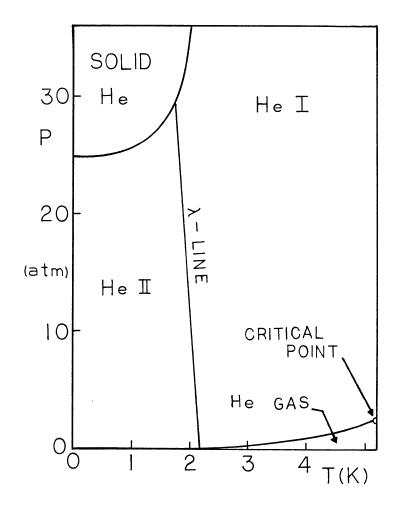 Figure 1. Phase Diagram of Liquid Helium When liquid helium is cooled to 2.172 K, it undergoes a phase transition (Figure 1). Because of the characteristic profile of the heat capacity curve, the temperature at which the transition takes place is called the lambda temperature (Tl). There is no specific volume change or latent heat involved in the lambda transition. Keesom and Wolfke (1927) used the terms He I and He II to distinguish the liquid above and below Tl respectively. He I behaves like a Newtonian fluid, while He II owing to its quantum effects has remarkably strange properties. In 1938, Kapitza and independently Allen and Misener reported that there is no measurable resistance to the flow of He II through small capillaries with diameter of the order of 10-4 cm (Kapitza 1938, Allen and Misener 1938). Kapitza referred to He II as the "superfluid". On the other hand, experiments using oscillating disks by Keesom and MacWood (1938) demonstrated the existence of a viscous drag, consistent with a viscosity coefficient not much less than that of helium gas. It seems as He II is capable of being both viscous and non-viscous at the same time. This led to the formulation of the two fluid model by Tisza and Landau. In addition to superfluidity, some of the remarkable properties of He II include extremely high thermal conductivity, the fountain effect, the mechano-caloric effect and the Rollin Film. 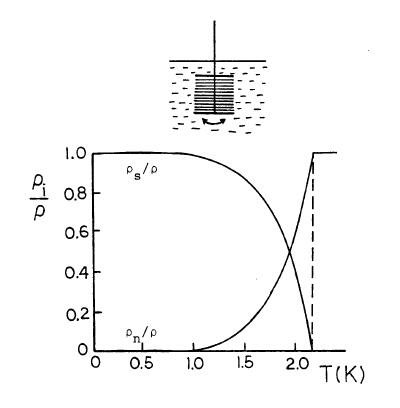 Figure 2. Andronikashvili's Experiment The Theory The two fluid model proposed by Tisza (1940) and Landau (1941) independently postulates that He II is mode of two fluids, namely the normal fluid and superfluid (Figure 2). Further, the sum of the normal fluid density and the superfluid density is equal to the bulk fluid density r = rn + rs............... ..............................................Eq (1)where r is the density of He II, rn and rs are the density of the normal and superfluid respectively. At Tl, only normal fluid is present in He II. As the temperature is decreased, more and more normal fluid is transformed into superfluid. Finally, at absolute zero temperature (if it can be reached), He II consists of superfluid only. The essential parameters of the two fluid model are summarized in Table 1. The normal fluid behaves like a Newtonian fluid. It has finite viscosity and is the only entropy carrying component in the system. Superfluid on the other hand has no viscosity and does not carry any heat.
The total mass flux density of He II is equal to the sum of the two components The total mass flux density of He II is equal to the sum of the two components J = rv = rnvn + rsvs..............................................Eq (2) The subscript n represents the normal fluid component and the subscript s represents the superfluid component. According to Landau (1941), the simplified equation of motion for the normal fluid and the superfluid can be written as  ...............Eq (3) ...............Eq (3)and  ...............................Eq (4) ...............................Eq (4)where grad P and grad T are the pressure gradient and temperature gradient and hn is the viscosity of the normal fluid. The chemical potential is denoted by Do You Know Someone Who Needs A Job in Engineering, Physics or Chemistry? About the author- Dr. Sidney Yuan is a consultant in the field of Low Temperature Physics and Cryogenics, and has written a Book on Cryogenics and published extensively in the field. E-Mail. Bookmark This Page Send This Page To A Friend 
Place Your Ad Here For As Little As $1 Per Day About Us | Add URL | Advertise with Us | Auction | Awards | Contact Us | Discussion Forum | Links | Search This Site | Send This Page | Shop | Top Ten Sites Copyright 2000 Yutopian, All Rights Reserved |
||||||||||||||||||||
                            |